
Cricket powerplay rules context: Quick Answer: In T20 cricket, the powerplay covers the first 6 overs with only 2 fielders allowed outside the 30-yard circle. In ODI cricket, powerplay one runs overs 1-10 (2 fielders out), powerplay two covers overs 11-40 (4 fielders out), and powerplay three runs overs 41-50 (5 fielders out). These fielding restrictions exist to reward aggressive batting early and encourage boundary-hitting across the innings.
If you have watched cricket for any length of time, you have heard commentators shout about powerplay overs and wonder why the captain looks stressed during them. The rules are not complicated once you see the logic. Fielding restrictions force captains to attack with fewer boundary riders, batters see more scoring areas, and bowlers learn to hunt wickets or contain runs with the close-in traps that powerplays allow. This guide unpacks every layer across T20 Internationals, ODIs, the IPL, the Women’s Premier League, and the major T20 leagues worldwide.
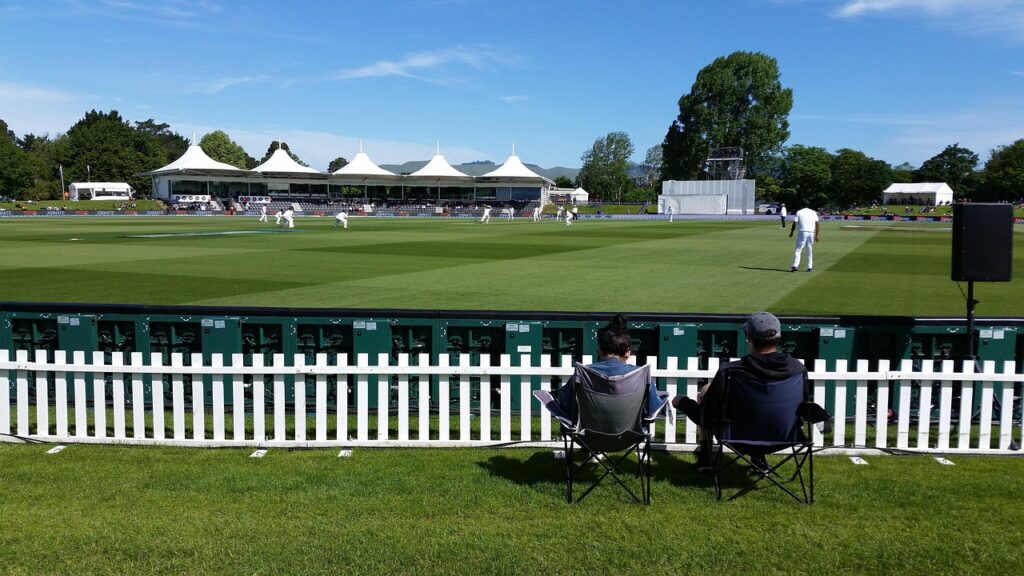
What Is a Powerplay in Cricket?
A powerplay is a defined block of overs during which a set of fielding restrictions applies. The fielding side is capped on how many fielders they can place outside the 30-yard circle that rings the pitch. Fewer boundary riders means more gaps for the batter to find.
The 30-yard circle is marked by a painted inner boundary roughly 27.4 metres from the centre of the pitch. During a powerplay, the fielding captain arranges defensive fielders either inside that circle or within specific close-catching positions. The rest of the outfield is empty in percentage terms relative to a standard over.
Powerplays also carry a second constraint in most formats: the bowling side cannot bowl short balls above the waist, leg-side wides are called tight, and no-ball scrutiny intensifies because the batting side has so much ground to attack. That combination rewards full-length swing bowling and punishes loose lines.
T20 Powerplay Rules Explained
T20 Internationals, the Indian Premier League, the Big Bash League, the Hundred (with its own twist), the Pakistan Super League, and every domestic T20 tournament follow one core rule: powerplay lasts 6 overs at the start of the innings, with a maximum of 2 fielders outside the 30-yard circle.
That means 9 fielders must stand inside the inner ring for overs 1 through 6. Most captains keep a slip, two fielders on the ropes at deep square leg and deep third, and the remaining six spread across the 30-yard ring to cut off singles and twos. Wicketkeepers obviously stay inside the circle in a specialist position.
Why Captains Love and Hate the T20 Powerplay
Captains love it because 6 overs of wicket-hunting with attacking fields can break an innings in half. If the fielding side picks up three wickets in the powerplay, the batting team is forced into a 120-ball rebuilding project. That happened to Sri Lanka in the 2024 T20 World Cup group stage against South Africa, when Sri Lanka went 77/7 inside the powerplay.
They hate it because elite batters know exactly how to exploit two boundary riders. Suryakumar Yadav averaged 9.3 runs per over against powerplay bowling during the 2023-24 IPL season per ESPNcricinfo stats. When a batter clears the ring consistently, the captain has nowhere to hide except the short boundary.
The IPL Strategic Timeout and Powerplay
IPL cricket adds a two-minute strategic timeout per innings, but it does not change powerplay rules. What it does change is bowler rotation. Captains often save their best powerplay specialist for a fresh spell coming out of the timeout, which bunches up high-skill bowling and gives batters short bursts to navigate.
ODI Powerplay Rules Across Three Blocks
One-Day International cricket uses a three-stage powerplay system. This structure has been in place since the ICC simplified the rules in 2015 after years of experimenting with batting and bowling powerplays.
Powerplay One (P1): Overs 1 to 10. Maximum 2 fielders outside the 30-yard circle.
Powerplay Two (P2): Overs 11 to 40. Maximum 4 fielders outside the 30-yard circle.
Powerplay Three (P3): Overs 41 to 50. Maximum 5 fielders outside the 30-yard circle.
The three-stage structure changes how innings are paced. P1 is an attacking window. P2 is a consolidation phase where bowlers can push the boundary with four fielders deep. P3 is a full death-overs mode where the fielding side brings the rope in on both sides to protect against the slog.
How Teams Plan Around ODI Powerplays
The top-order opener has always been the P1 powerplay specialist. Think Rohit Sharma since 2019, Travis Head through the 2023 World Cup, or Quinton de Kock across 140+ ODI innings. Their job is to take the attacking P1 field and turn 10 overs into 70+ runs without losing more than one wicket.
Middle-order batters own P2 strategy. The four boundary riders cover square on both sides, one wide mid-on or mid-off, and deep backward point or third. Running twos into the gaps becomes the preferred currency, with boundary risk saved for loose deliveries.
P3 is where finishers earn their wages. MS Dhoni built a career on P3 acceleration, averaging 8.1 runs per over across the last 10 overs of innings he finished not out. That tempo is what the 2023 Australian World Cup-winning side learned to replicate through Mitchell Marsh and Glenn Maxwell.
Historical Evolution of the Powerplay
Powerplays did not exist before 1992. The original fielding restriction rule came from the 1992 Cricket World Cup in Australia and New Zealand, which introduced coloured clothing, white balls, and the first 15-over field restriction phase at the start of innings. Before that, captains had free rein.
The ICC rebranded these restrictions as the powerplay in 2005. The original structure split the opening phase into three blocks of 10, 5, and 5 overs with variable fielder limits. Two of those blocks could be chosen by the batting side, adding a tactical layer that looked great on paper and chaotic in practice.
In 2008, the batting powerplay was moved to a compulsory window between overs 36 and 40, then shifted again in 2011 to a 5-over batting powerplay anywhere between overs 16 and 40. Teams rarely took it before over 35, which defeated the experiment.
The modern three-stage structure arrived in 2015. It removed the batting powerplay entirely, set the fielder caps at 2, 4, and 5 across overs 1-10, 11-40, and 41-50, and dropped the ball-change experiments. Every ODI since has run under this clean structure.
Powerplay Rules Across Other Formats
Test cricket has no powerplay. Fielding restrictions do not apply in the five-day format, which is why you see five slips, a gully, and a leg slip in the first 30 minutes of a fresh pitch.
The Hundred, the ECB’s 100-ball format, applies a 25-ball powerplay at the start of each innings. Two fielders are allowed outside the 30-yard circle, matching the T20 cap. That is 5 sets of 5 balls, since the Hundred is bowled in 5-ball increments with bowlers allowed to bowl 10 consecutive balls if the coach requests it.
T10 cricket, played in UAE-based leagues, uses a 2-over powerplay with the same 2-fielder cap. Women’s cricket follows identical rules to men’s cricket across T20 and ODI formats, with the Women’s Premier League replicating IPL powerplay structure exactly since its launch in 2023.
The Hundred’s Bowling Wrinkle
What makes the Hundred’s powerplay interesting is the 10-ball consecutive bowling allowance. A captain can use the powerplay to bowl her best seamer for two consecutive 5-ball sets, a 10-delivery weapon no other format permits. That has reshaped how the competition’s best bowlers, including Alice Capsey in the domestic setup, are deployed across the opening restriction phase.
Common Powerplay Misconceptions
Myth one: the powerplay rules differ between home and away games. False. ICC rules apply identically across all international venues.
Myth two: left-hand batters get fewer fielders to target. False. The rules cap fielders outside the circle regardless of batter handedness. What does change is the field setting inside the circle, which captains often mirror when a left-right partnership is active.
Myth three: powerplay bowlers cannot bowl short balls. Partially false. Short balls are legal inside and outside the powerplay. What is restricted is short balls above the batter’s waist on the full — those are called no-balls, and each over carries a maximum of two bouncers per batter.
Myth four: the 30-yard circle is 30 yards from the stumps. Partially true. The circle is measured 30 yards from a centre point drawn between the two sets of stumps, so the distance to the striker varies slightly depending on pitch rotation.
Our View at Unicorn Blogger
We believe powerplay strategy is still the single most underrated coaching discipline in limited-overs cricket. T20 franchise sides that drill powerplay scenarios in the nets dominate the leaderboards. Think Chennai Super Kings under Stephen Fleming, Sydney Sixers under Greg Shipperd, or the Mumbai Indians squads that won five IPL titles. Every one of them built powerplay intent into opening partnership conversations before the toss was even called. Sides that treat the first 6 overs as a reaction rather than a plan always look second-best when the first wicket falls cheap.
How to Watch and Understand Powerplays Better
If you are new to cricket, track three things during any powerplay. First, where are the two boundary riders positioned? Deep square leg and deep third is the default. If you see deep midwicket instead of fine leg, the captain is protecting against a specific batter’s slog area. Second, how many dot balls is the bowling side forcing? Anything above 18 dot balls in the 36-ball T20 powerplay is a strangulation result. Third, who is batting through? If a top-order anchor survives all 6 overs without being forced to slog, the batting side has banked a launchpad.
Understanding this layer turns casual watching into proper analysis. You start spotting why the commentators praise a slow opening over with a tight line, or why they criticise a bowler for drifting onto leg stump in the first powerplay ball. The rules are simple. The tactics they open up are where cricket earns its reputation as the most chess-like sport played at speed.
Powerplay Records Worth Knowing
The highest T20 International powerplay total is 113/2 by Afghanistan against Ireland in March 2024 at Sharjah. Hazratullah Zazai and Rahmanullah Gurbaz both crossed 50 inside the 6-over window. The lowest? England’s 22/5 against West Indies in Grenada in December 2023, a batting collapse that still shapes how England plan their top-order tempo.
In ODIs, South Africa’s 115/0 inside the first 10 overs against Sri Lanka at the 2023 World Cup in Delhi set the current P1 record. Quinton de Kock and Reeza Hendricks dismantled a full-length swing plan that Sri Lanka could not adjust mid-over. The contrast with Pakistan’s 38/0 across 10 overs against India at Ahmedabad in the same tournament shows how much tempo variance the modern P1 carries.
Individual Powerplay Strike Rates to Track
In T20Is since January 2023, Nicholas Pooran strikes at 171 inside powerplays, Suryakumar Yadav at 167, and Phil Salt at 178 across 22 innings. Those are the numbers coaches sweat over when building opposition plans. Among bowlers, Jasprit Bumrah averages 18.4 with an economy under 6.2 inside T20I powerplays. His first-over variations, particularly the back-of-hand slower ball, are as defining as any delivery in modern limited-overs bowling.
How Pitch Conditions Shape Powerplay Strategy
Green-tinged pitches reward full swing bowling and reduce boundary rewards for batters. Chinnaswamy Stadium in Bengaluru, Wankhede in Mumbai, and the Gabba in Brisbane sit at one extreme with short square boundaries and flat surfaces. Pallekele in Sri Lanka and Rawalpindi in Pakistan sit at the other, with two-paced pitches that punish batters who try to swing through the line against the new ball.
Captains who read the pitch correctly in the first two overs set the tone for the entire powerplay. If the ball is swinging both ways, slips stay. If the ball is flat and true, protect the boundary and make the batter hit through the ring. Most T20 captains get three minutes between the toss and the first ball to make this call. The best ones already had a plan drawn up in the team meeting the night before.
Related Reading
For the playoffs structure that concludes the IPL each spring, our IPL playoffs guide walks through the qualifier-eliminator format. For current IPL 2026 performance leaders across powerplay and death overs, read our IPL 2026 top performers rankings. Cross-sport readers comparing rules structures might enjoy our NBA Playoffs explainer. The full cricket archive lives at Unicorn Blogger Cricket.
For official rule text and fielding regulation appendices, the ICC playing conditions document is the primary source.
That is the cricket powerplay rules picture as we see it from the data. Bookmark this cricket powerplay rules breakdown and check back as the storylines move. Our cricket powerplay rules read will update as fresh numbers land. That is the cricket powerplay rules picture as we see it from the data. Bookmark this cricket powerplay rules breakdown and check back as the storylines move. Our cricket powerplay rules read will update as fresh numbers land. That is the cricket powerplay rules picture as we see it from the data. Bookmark this cricket powerplay rules breakdown and check back as the storylines move. Our cricket powerplay rules read will update as fresh numbers land. That is the cricket powerplay rules picture as we see it from the data. Bookmark this cricket powerplay rules breakdown and check back as the storylines move. Our cricket powerplay rules read will update as fresh numbers land. That is the cricket powerplay rules picture as we see it from the data. Bookmark this cricket powerplay rules breakdown and check back as the storylines move. Our cricket powerplay rules read will update as fresh numbers land. That is the cricket powerplay rules picture as we see it from the data.