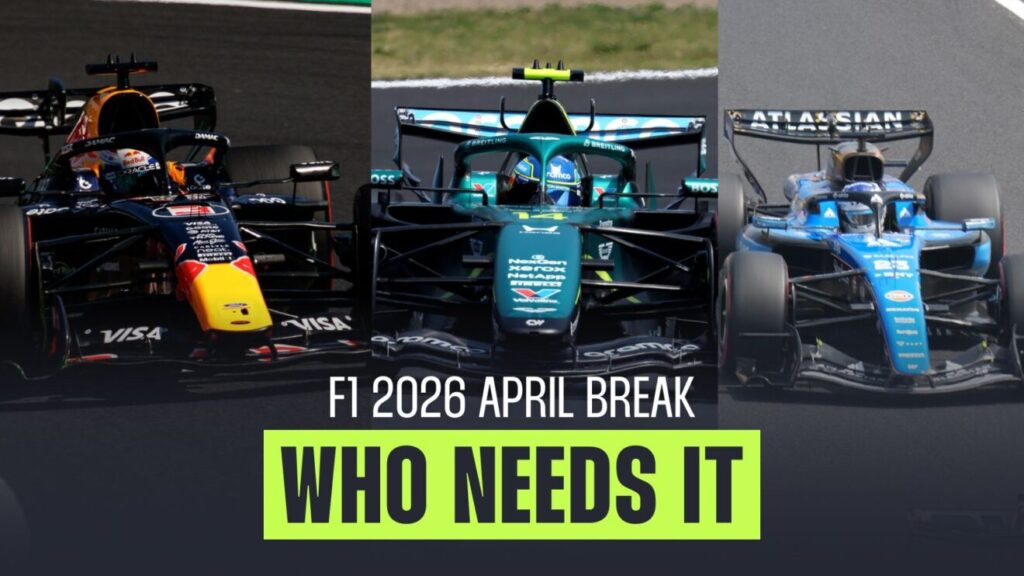
Three races. Three Mercedes wins. One nineteen-year-old at the top of the standings. After Kimi Antonelli’s history-making victory in Japan, Formula 1 enters its April break with a championship picture that nobody predicted and a set of fundamental questions that every team on the grid must answer before the Miami Grand Prix on May 1. This is a critical month — not for racing, but for preparation. Here is what each major team needs to resolve before the circus lands in Florida.
The State of Play After Three Rounds
Andrea Kimi Antonelli leads the Drivers’ Championship with a nine-point buffer over Mercedes teammate George Russell, making it the first time in F1 history that a teenager has led the standings. Charles Leclerc sits third for Ferrari, while McLaren’s Oscar Piastri is fourth despite taking his first podium of the season in Japan. The Constructors’ standings have Mercedes well clear, with Ferrari in second and McLaren hauling themselves into third.
The F1 2026 power unit regulations are clearly driving the hierarchy. The new 50/50 split between internal combustion and electrical power deployment has produced a dramatically different car balance to anything seen in the previous era, and those who mastered the electrical energy management — Mercedes first among them — have started the season in another stratosphere.
Mercedes: Protect, Don’t Overcorrect
Mercedes have won all three races. Their temptation in the April break will be to double down on what is already working. The risk is overcorrection — pushing development tokens towards systems that don’t need fixing rather than scouting for the weaknesses rivals will identify by Miami. The Bearman crash in Japan highlighted one specific area: the energy deployment modes at high-speed corners are creating dangerous speed differentials between cars using different strategies on the same lap. The FIA will review this on April 9. Mercedes need to be prepared for regulation tweaks that could clip their advantage slightly and have contingency mapping ready.
On the driver side, George Russell’s public frustration over Safety Car timing in Japan is a storyline the team need to manage. Russell is four points behind his teammate. If that gap grows in Miami, team dynamics become a genuine conversation before the season reaches its first truly decisive phase.
Ferrari: The Upgrade They Cannot Afford to Get Wrong
Ferrari enter the April break knowing they have pace — Leclerc’s third place in Japan and Lewis Hamilton’s sixth confirm the car is fundamentally competitive — but knowing equally that their energy recovery system is running three to four percent below what Mercedes is achieving in the high-speed deployment zones. Ferrari’s technical director confirmed a major upgrade package is coming for Miami, and sources within the team suggest it targets exactly this deficit.
The risk for Ferrari is the same one that has haunted them for the past decade: an upgrade that fixes one problem by creating another. Their 2026 floor and diffuser package has been working well in its current form. If the Miami upgrade disrupts floor balance even marginally, they could arrive in Florida slower than they left Japan. Precision over ambition is the mandate from the Maranello engineers heading into this break.
McLaren: Understanding the Podium Gap
Piastri’s podium in Japan was McLaren’s first of the season and came in unusual circumstances — he led early, pitted well, and benefited from the Safety Car pattern aligning in his favour. The honest assessment from Zak Brown and Andrea Stella post-race was that the car is not yet consistently podium-ready on merit. McLaren are running approximately five percent below Mercedes in electrical deployment efficiency, and their mechanical grip on the slower corners in Suzuka’s complex was also visibly inferior to Ferrari.
Norris’s fifth place compounds the concern: the British driver has the title credentials on paper but has found himself unable to string together consecutive strong qualifying laps in a car that remains sensitive to setup. McLaren’s April work must centre on stability — finding a baseline setup that performs across different circuit types rather than one optimised specifically for one track.
Red Bull: Verstappen’s Patience Is Being Tested
Max Verstappen finished eighth in Japan. Eighth. The four-time world champion started eleventh and made progress — but a Red Bull capable of fighting for race wins in 2025 finishing eighth in a straight race in 2026 tells you everything about the scale of their power unit deficit. Honda’s electrical system is the core problem, and it is not one that can be solved with an aerodynamic upgrade package. Red Bull have historically been the best development team in the sport, but 2026’s regulations have penalised those who struggled to optimise electrical energy management from day one, and Red Bull are firmly in that group.
Christian Horner has been measured in his public comments, but the frustration is visible when you look at the lap time data. Verstappen is still the best driver in the field on a good day. He simply does not currently have the car to express that talent.
Our View at Unicorn Blogger
We think Ferrari emerge from the April break as the most improved team relative to their current position. Their engineering culture has been more methodical in 2026 than in previous seasons, and the targeted nature of their Miami upgrade — focused on a specific, identified deficit rather than a broad rethink — is the right approach. We are calling a Ferrari win in Miami. Not because Mercedes will collapse, but because Leclerc on a street circuit in Florida, with a targeted power unit upgrade closing the gap, is a combination that should not be underestimated. Antonelli’s championship lead survives Miami, but only just.
Key Takeaways
- Kimi Antonelli leads the 2026 F1 championship at 19 years old, the youngest driver in history to hold the standings lead.
- Mercedes have won all three races but face a potential FIA regulation review on energy deployment modes after the Bearman crash in Japan.
- Ferrari are targeting a major upgrade package for Miami focused specifically on electrical energy recovery efficiency.
- McLaren need setup stability across circuit types, not track-specific performance, to convert pace into consistent podiums.
- Red Bull’s deficit is a power unit problem, not an aerodynamic one — the April break does not solve their core issue.
Frequently Asked Questions
When is the next F1 race in 2026?
After the Japanese Grand Prix on March 29, the 2026 Formula 1 season takes an April break. The next race is the Miami Grand Prix, which takes place from May 1 to 3, 2026. The Miami International Autodrome at Hard Rock Stadium hosts the race, making it the fourth round of the 2026 World Championship and the first time the field races on American soil this season.
Who leads the F1 2026 Drivers’ Championship?
Kimi Antonelli leads the 2026 F1 Drivers’ Championship following his win at the Japanese Grand Prix in Suzuka. At 19 years and 216 days old, he became the youngest driver in Formula 1 history to lead the standings. He holds a nine-point lead over his Mercedes teammate George Russell, with Ferrari’s Charles Leclerc third.
Why did Ollie Bearman crash at the Japanese Grand Prix?
Ollie Bearman’s crash at the Japanese Grand Prix was attributed to a speed differential caused by different electrical energy deployment strategies between Bearman’s Haas and Franco Colapinto’s Alpine ahead of him on the run to the Spoon Curve. The new 2026 regulations allow teams to choose when to deploy battery energy, creating significant differences in straightline speed between cars in close proximity. The FIA is reviewing the regulations on April 9 to determine whether changes are needed before Miami.
What is the F1 2026 power unit format?
The 2026 Formula 1 regulations introduced a new power unit format with a 50/50 split between internal combustion engine output and electrical power deployment. This is a significant increase in electrical contribution compared to the previous era and has fundamentally altered the balance of performance between teams. Mercedes has optimised this system most effectively in the opening three rounds, giving them a considerable performance advantage over rivals still climbing the development curve.
For more F1 coverage, visit our Motorsport section. Read our Kimi Antonelli championship analysis and follow the season at formula1.com and follow the championship standings and team updates at Motorsport.com.