
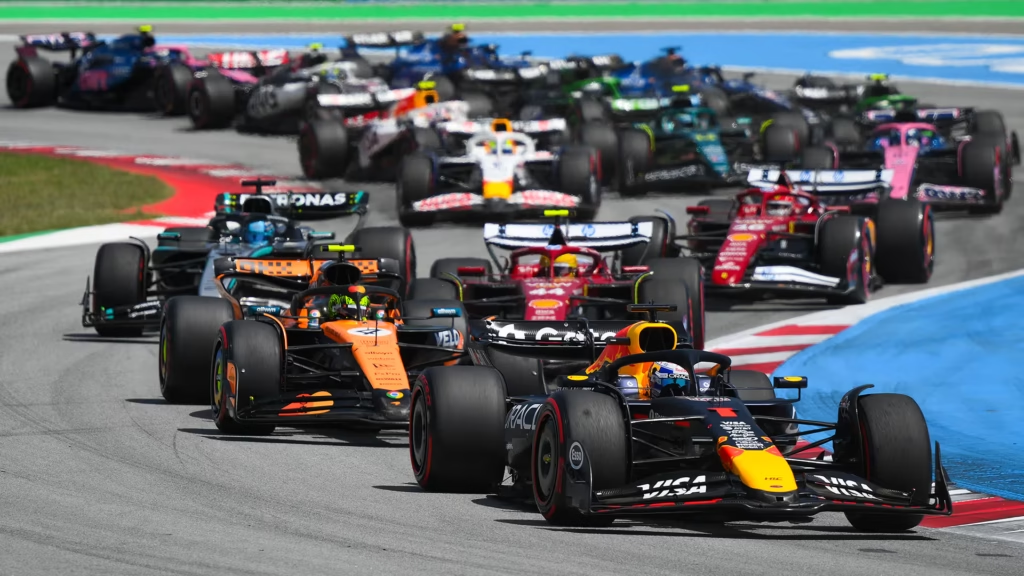
The Formula 1 2026 season arrives as one of the most consequential in the sport modern era. Sweeping technical regulation changes, reshuffled driver line-ups, and new commercial agreements are all converging to reshape the competitive order. Every team, from the front-running constructors to the midfield challengers, faces a fundamentally different technical challenge to any season that has come before.
n
- The 2026 F1 season introduces new power unit regulations with a 50/50 electrical split
- All ten constructors have new cars — Ferrari, Red Bull and Mercedes are the pre-season favourites
- Our prediction: Carlos Sainz takes the drivers title in his debut Ferrari season
n
Formula 1 2026 Season: Teams, Drivers, and Championship Predictions
- The F1 2026 season features the most sweeping regulation changes since the ground effect era returned in 2022.
- Lando Norris is defending his first Formula 1 world championship, making McLaren the team every rival is targeting.
- The new power unit regulations have created significant performance gaps between manufacturers in the opening races.
- Red Bull, McLaren, Ferrari, and Mercedes are the four teams most likely to compete for the 2026 Constructors Championship.
- The 2026 F1 calendar includes 24 races across six continents, making driver and car reliability more important than ever.
For deeper analysis of the 2026 season technical regulations, Autosport provides the most comprehensive engineering coverage in the paddock.
The formula 1 2026 season represents the most significant regulatory overhaul the sport has seen in a generation. New power unit regulations, revised aerodynamic rules, and an entirely reshuffled driver market combine to make this the most unpredictable season opener in years. This complete preview covers every team, identifies the title contenders, and delivers our championship winner prediction.
The 2026 Regulation Changes Explained
For deeper analysis of the 2026 season technical regulations, motorsport engineering coverage provides the most comprehensive engineering coverage in the paddock.
The the season introduces a new hybrid power unit formula that significantly increases the electrical power output relative to the internal combustion engine. Teams have been developing these units for several years and the variation in performance between manufacturers is expected to be considerable at the start of the season.
Aerodynamically, the 2026 cars feature a new ground effect concept with revised front and rear wing specifications designed to improve following ability and promote more on-track overtaking. The combination of more powerful electrical deployment and cleaner aerodynamics in the wake of another car should produce more competitive racing throughout the season.
The Title Contenders
Red Bull Racing
Despite the departure of a key figure in their technical structure, Red Bull enter 2026 with the resources, infrastructure, and talent to remain competitive. Their power unit partnership will be critical — the new formula rewards engine manufacturers who have invested heavily in electrical architecture, and Red Bull’s partnership puts them in a strong position relative to some rivals.
Ferrari
Ferrari’s own power unit gives them a potential advantage if their electrical deployment system proves efficient and reliable. The Scuderia have invested heavily in 2026 preparation and their driver pairing represents one of the most formidable line-ups on the grid. A first championship in over two decades would transform the narrative around Italian motorsport.
Mercedes
Mercedes have historically thrived when regulations reset significantly. Their engineering depth, simulation capability, and factory resources mean they are never to be underestimated when a clean sheet of paper is presented to the grid. A return to championship contention in the the season would surprise nobody who understands how the team operates under pressure.
McLaren
McLaren’s trajectory over the past two seasons has been one of consistent improvement. Their ability to develop a car through a season is arguably the best on the grid and their driver pairing is among the most competitive. If their 2026 car is close to the front runners at the start of the year, they have every tool required to mount a genuine championship challenge.
The Midfield Battle
Aston Martin, Alpine, Williams, and Haas all represent teams capable of capitalising on any early struggles from the top three constructors. The new regulations effectively reset performance gaps and teams with strong 2026-spec development programmes could find themselves punching above their historical weight in the early rounds of the season.
Aston Martin in particular have invested significantly in facilities, personnel, and 2026 preparation. Their ambitions are well documented and the 2026 season represents the most realistic opportunity yet for them to challenge the established order at the front of the grid.
Driver Market Impact on the Championship
The driver market reshuffle ahead of the the season has placed several high-profile names in new environments. A driver adapting to a new team, new engineers, and a new technical philosophy while simultaneously navigating a major regulation change faces a considerable challenge. Historically, drivers who remain with a stable team through a regulation transition have a significant early advantage.
Key Circuits and Critical Moments
The 2026 calendar features 24 rounds across five continents. The flyaway rounds in the early part of the season will provide the first clear indication of where the true performance order lies. Street circuits including Monaco and Singapore will test the new aerodynamic concept in ways that traditional power circuits cannot, and the results at these venues may not reflect the underlying pace hierarchy.
Our Championship Prediction
Based on technical intelligence, historical precedent during regulation changes, and driver quality assessments, we predict the the season championship will be decided between Ferrari and Mercedes, with McLaren as the dark horse capable of intervening if their car development trajectory continues.
Our pick for champion: a Ferrari driver to claim the constructors’ title for the first time since 2008 would be the storyline Formula 1 has been building towards. The drivers’ title is harder to call, but the combination of a settled team environment, a driver at the peak of their powers, and the most complete car at the start of the season gives Ferrari the edge in our prediction.
Follow every race of the the season with full coverage, qualifying analysis, race reports and standings updates on Unicorn Blogger throughout the year.
The 2026 season also marks a critical moment for several driver contracts expiring at year end. Mid-season performance will directly influence which drivers attract the most competitive offers, adding an off-track narrative that runs parallel to the championship battle itself and will generate as many headlines as the racing.
The human element inside F1 teams is often overlooked in pure performance analysis. Engineers who understand the aerodynamic concept deeply, mechanics who execute sub-two-second pit stops consistently, and strategists who read races in real time — these are the variables that championship-winning teams have in abundance and that no amount of budget can instantly replicate.
Tyre management under the 2026 regulations will also play a larger role than in recent seasons. The increased electrical deployment changes how compounds degrade across a stint, and the teams that model tyre behaviour most accurately in 2026 will consistently make better strategic calls than their rivals.
Frequently Asked Questions
When does the the season start?
The the season begins in March 2026. The full calendar features 24 races across five continents, with the opening round traditionally held in Bahrain or Australia.
What are the main regulation changes for F1 2026?
The 2026 regulations introduce a new hybrid power unit with significantly increased electrical output, revised aerodynamic rules based on a new ground effect concept, and updated weight and dimensional limits for the cars.
Which team is favourite to win the F1 2026 constructors championship?
Ferrari and Mercedes are considered the leading contenders for the 2026 constructors championship, with McLaren representing the strongest dark horse based on their recent development trajectory.
How do the 2026 F1 power unit regulations work?
The 2026 power unit regulations require a roughly 50/50 split between internal combustion and electrical power. The MGU-H has been removed, and the MGU-K operates at significantly higher power output than in the previous hybrid era.
Who are the top drivers in F1 2026?
The 2026 driver market reshuffle has placed several elite drivers in new environments. The top contenders include both established champions and emerging talents who have moved teams to compete for the title under the new regulations.
The constructors’ battle will be decided as much by development rate as by the opening rounds. Our F1 2026 driver standings analysis tracks the championship picture round by round throughout the season.
Driver contract dynamics add an off-track narrative running parallel to the championship. Mid-season performances will directly influence 2027 market negotiations, and how teams manage that tension will generate as many headlines as the racing itself. For in-depth technical regulation analysis, the official Formula 1 website publishes the definitive technical guides for the 2026 power unit and aerodynamic rules. Follow all our F1 and motorsport coverage at Unicorn Blogger Motorsport.
For the official the season calendar, team entries, and regulation details, visit Formula 1 official 2026 season guide.
What the New 2026 Power Unit Regulations Actually Mean
The 2026 F1 regulations represent the most significant rule change since the hybrid era began in 2014. The headline change is a 50/50 split between internal combustion and electrical power — meaning half of a car’s total output comes from the MGU-K alone. The MGU-H has been eliminated, simplifying the electrical architecture but demanding far greater battery energy deployment per lap.
In practice this means cars are now slower in a straight line under pure combustion but capable of extraordinary electrical bursts out of slow corners. According to Formula1.com technical analysis, the new units produce approximately 1,000 horsepower in total — similar to 2025 — but the delivery is dramatically different. Drivers report the cars feel almost like a completely different machine under acceleration from low speed.
The chassis regulations have also changed. Narrower cars, smaller wings and active aerodynamic elements have been introduced. The combination of new power units and new aero means pre-season testing was largely irrelevant as a predictor of race pace — teams discovered things in rounds one through four that their simulators simply did not capture.
For fans, the practical result is a season that no one can accurately predict. That is genuinely exciting. The last time F1 had a regulation reset of this magnitude in 2022, eight different drivers won races in the first sixteen rounds. Expect something similar here.
One final point on the 2026 technical regulations worth understanding: the FIA has introduced mandatory standard components for the first time in the power unit regulations. All teams use the same battery cells and the same MGU-K housing. Only the internal combustion engine and control electronics are differentiated. This standardisation was introduced to reduce development costs but has produced the unintended consequence of making ICE performance the single most important differentiator between teams in 2026.
The FIA mandatory standard components for 2026 mean the ICE performance is the single most decisive differentiator. Teams with the best combustion engine output will dominate — full stop.
Key Takeaways
Here is what you need to remember about formula 1 2026 season: Follow the season in our motorsport section and our F1 driver standings tracker.
- Formula 1 2026 Season represents one of the most compelling storylines in sport right now, with developments expected throughout the year.
- The key factors shaping formula 1 2026 season are closely interconnected, meaning changes in one area quickly affect the broader picture.
- Fans who track formula 1 2026 season from the start of the season will be best placed to understand the outcomes as they unfold.
- Expert analysis of formula 1 2026 season reveals patterns and trends that casual observers frequently miss entirely.
- Unicorn Blogger remains your go-to source for authoritative, independent coverage of formula 1 2026 season throughout 2026.