Fourteen days. That is all that stands between the final buzzer of the NBA regular season and the moment the real drama begins. The NBA Play-In Tournament has quietly become one of the most compelling formats in professional sport since its introduction — a sudden-death mini-playoff that gives fringe contenders a lifeline and takes established franchises to the brink of embarrassment. But for all its entertainment value, plenty of fans still aren’t entirely sure how it works. This guide settles that once and for all.
What Is the NBA Play-In Tournament?
The NBA Play-In Tournament is a four-day event held each April, bridging the gap between the regular season and the full NBA Playoffs. It features the teams seeded seventh through tenth in each of the two conferences — the Eastern Conference and the Western Conference — competing for the final two playoff spots in each bracket.
The format was introduced on a trial basis during the COVID-shortened 2020-21 season and proved immediately popular. The NBA made it permanent from the 2021-22 season onwards. The simple reason: it keeps more teams — and more fanbases — relevant deep into April, rather than a small group of franchises mathematically eliminated before the season ends.
In 2026, the Play-In Tournament runs from April 14 to 17, with the full NBA Playoffs beginning on April 18.
How Does the Play-In Tournament Work?
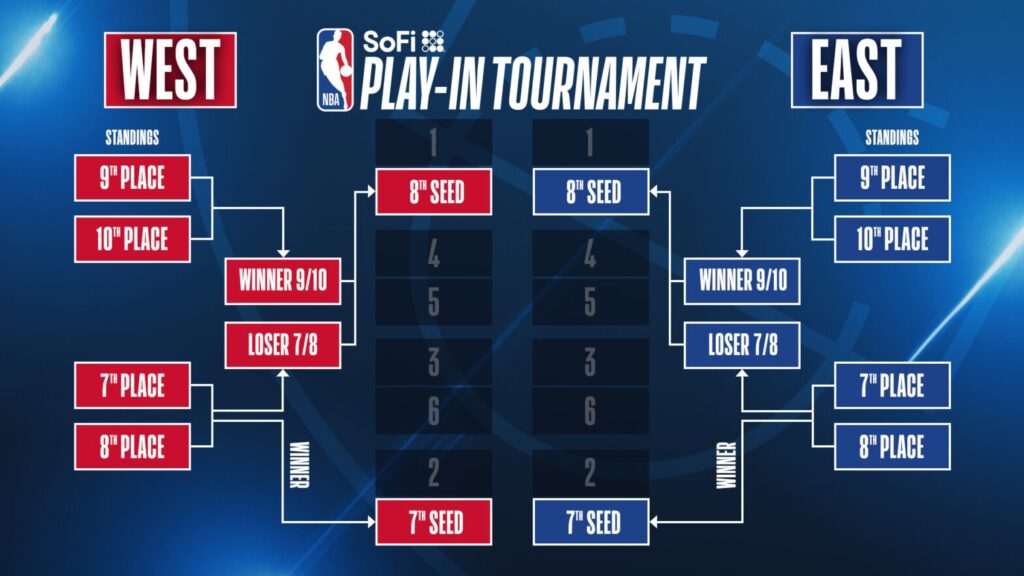
Each conference runs its own Play-In bracket independently. Within each conference, the No. 7 seed hosts the No. 8 seed in a single game. The winner of that match earns the No. 7 playoff seed and faces the No. 2 seed in the first round of the playoffs.
Simultaneously, the No. 9 seed hosts the No. 10 seed. The loser of that match is eliminated from the postseason entirely.
The two losers from the 7-8 game and the 9-10 game then play a final elimination match. The winner of that game becomes the No. 8 playoff seed and faces the conference’s No. 1 seed in the first round. The loser is done for the season.
To summarise the paths:
- 7 seed wins: Straight to the No. 7 playoff spot — faces the No. 2 seed in Round 1
- 8 seed wins: Straight to the No. 7 playoff spot — faces the No. 2 seed in Round 1
- 9 or 10 seed wins the consolation game: Earns the No. 8 playoff spot — faces the No. 1 seed in Round 1
- Losers of 7-8 and 9-10 games play off: Winner gets No. 8 seed, loser goes home
NBA Play-In Tournament 2026 — Key Things to Know
The 2026 Play-In field is set to feature some high-profile franchises. In the Eastern Conference, the Toronto Raptors and Charlotte Hornets hold the 7-8 seeds, while the Orlando Magic and Miami Heat occupy 9-10. Out West, the Phoenix Suns and Portland Trail Blazers are in the 7-8 spots, with the Los Angeles Clippers and Golden State Warriors rounding out the 9-10 positions.
Home Court Advantage Matters
Unlike the full playoffs where home court is determined by overall record, in the Play-In Tournament, the higher seed always hosts the first game. So the No. 7 seed hosts the No. 8, and the No. 9 seed hosts the No. 10. In the elimination game (the 7-8 loser vs 9-10 winner), home court goes to the higher remaining seed.
One Loss Is Not the End
A crucial feature of the format is that the seventh and eighth seeds each get two chances to advance. If the No. 7 seed loses their first game, they simply drop into the elimination game — they are still alive. The No. 8 seed, having already played one win-or-go-home game, gets a second chance in the same elimination bracket. Only the No. 9 and No. 10 seeds have just a single game to prove themselves.
Why the NBA Play-In Tournament Changes the Stakes
From a strategic perspective, the Play-In Tournament has fundamentally changed how teams approach the final weeks of the regular season. Historically, a team sitting in eighth place with no realistic shot at sixth had little incentive to push hard in April. Now, teams in seventh through tenth are fighting to host rather than travel, knowing that home court in a one-game format can be the difference between a playoff run and an early summer.
It also created a new kind of tension for the top seeds. The No. 1 seed now knows it could face a hot team that has just won two consecutive elimination games in high-pressure environments. In 2023, the Miami Heat memorably used the Play-In format as a springboard to the NBA Finals.
Our View at Unicorn Blogger
We think the Play-In Tournament is the best structural innovation in professional basketball in a generation. It does not dilute the playoffs — it enhances them. A team that needs two wins just to reach the first round is not a fluke; it has earned its place. The drama it creates in mid-April, when playoff basketball would otherwise be three weeks away, is exactly what the NBA needed to hold its audience through the post-All-Star lull. The format should be permanent, and it already is. Well done to the NBA for recognising a good idea when it saw one.
Key Takeaways
- The NBA Play-In Tournament features seeds 7-10 in each conference competing for the final two playoff spots.
- The No. 7 and No. 8 seeds each get two chances to qualify; the No. 9 and No. 10 seeds have just one shot.
- The 2026 Play-In Tournament runs from April 14 to 17, with the full playoffs beginning April 18.
- The winner of the Play-In elimination game earns the No. 8 seed and faces the No. 1 seed in Round 1.
- Home court in the Play-In goes to the higher seed in every match, making seeding battles in late March critical.
Frequently Asked Questions
How many teams play in the NBA Play-In Tournament?
Eight teams participate in total — four from the Eastern Conference and four from the Western Conference. These are the teams seeded seventh through tenth in each conference at the end of the regular season. The tournament produces two playoff qualifiers per conference, filling the No. 7 and No. 8 seeds.
Can a team seed higher than seventh play in the Play-In?
No. Only teams finishing seventh through tenth in their conference are eligible for the Play-In Tournament. Teams finishing in the top six spots automatically qualify for the full NBA Playoffs without needing to win a Play-In game. This is one reason why teams fight hard to finish sixth or better.
What happens if a team loses both Play-In games?
If the No. 7 seed loses their opening game and then loses the elimination game, they are eliminated. Similarly for the No. 8 seed. The No. 9 and No. 10 seeds only play one game each — a loss means immediate elimination. There is no further safety net in the Play-In format.
Is the Play-In Tournament part of the official NBA Playoffs?
No. The Play-In Tournament is a separate qualifying event, not officially counted as part of the NBA Playoffs. Wins and losses in the Play-In do not count towards a team’s playoff record. However, teams must win through the Play-In to earn a playoff seed, making it a necessary step for seeds 7-10.
How the Play-In Affects Playoff Seeding Strategy
One underappreciated consequence of the Play-In format is how it has changed the way teams approach the final month of the regular season. Previously, a team locked into the seventh seed had little incentive to push for sixth place — both results put you in the first round against a top team. Now, the incentive is stark: finishing sixth means automatic playoff entry with a guaranteed home game. Finishing seventh means you must win a Play-In game before the real work begins.
This shift in incentives has made late-season basketball significantly more competitive. Teams that might have rested starters in the past now play their full lineups into mid-April because dropping one seed — from sixth to seventh, or from eighth to ninth — has material consequences. The Detroit Pistons, currently cruising toward the No. 1 seed in the East despite Cade Cunningham’s absence, understand this arithmetic perfectly. Even the Oklahoma City Thunder at the top of the West are not resting Shai Gilgeous-Alexander meaninglessly, knowing that home court advantage through every round of the playoffs is worth protecting. The Play-In has made the NBA regular season relevant all the way to the final buzzer. That is exactly what any league structure should achieve.
Whether you’re a new NBA fan trying to follow along or a long-time follower who always found the format confusing, the Play-In Tournament is one of the most exciting concepts in sport. Keep it bookmarked. It starts April 14 and it will not disappoint. For more basketball analysis, head to our Basketball section or read our breakdown of the full NBA Playoffs 2026 first round. You can also find the official bracket at NBA.com and the official bracket breakdown at CBS Sports.