
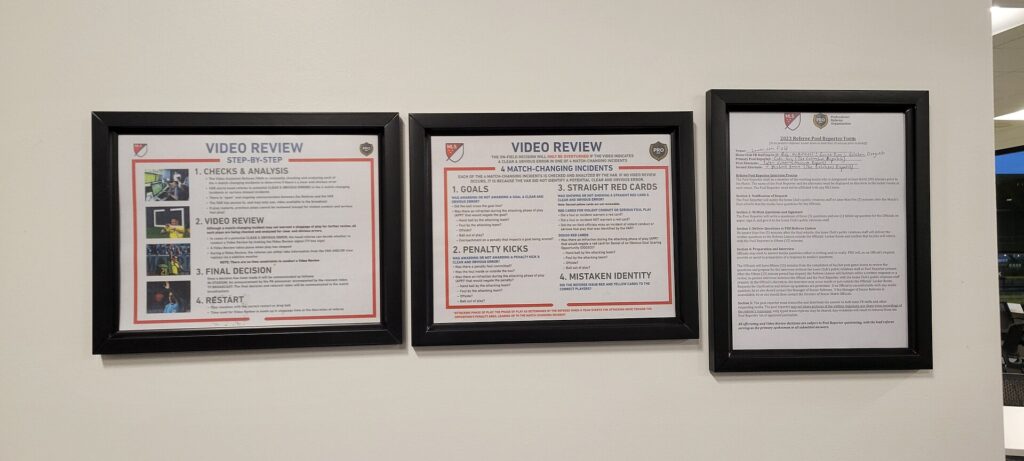
Premier League VAR steps in for only four kinds of incident, and it needs a clear and obvious error before it acts. Know that, and the long checks stop feeling random.
Quick answer: Premier League VAR is a team of Premier League officials at Stockley Park who watch a live feed and flag a clear and obvious error to the referee. They can review goals, penalties, direct red cards, and mistaken identity. Nothing else. The referee still makes the final call, often at the pitchside monitor.
Key Takeaways
- Premier League VAR can review just four incident types: goals, penalties, direct red cards, and mistaken identity.
- VAR only intervenes on a clear and obvious error, not on any call it would have judged differently.
- The chain runs check, then recommend, then on-field review, and the referee decides.
- Semi-automated offside technology now draws the offside line automatically, which speeds up tight calls.
- The officials sit at Stockley Park, watching every match on a live video feed.
What Is VAR? Premier League Video Assistant Referee Explained
Premier League VAR is short for Video Assistant Referee. Picture a small room, banks of screens, and a qualified referee watching your match unfold in real time. That room sits at Stockley Park, near Heathrow. The video assistant referee is not a robot. It is a person, backed by an assistant and a replay operator. Their job is narrow. They watch, they check, and they speak up only when something on the pitch looks so clearly wrong that leaving it uncorrected would embarrass the whole officiating team.
So VAR support is exactly that: support. The referee on the grass still runs the game. We think that single fact clears up half the arguments in the pub. VAR does not re-referee the whole ninety minutes. It watches for one thing.
The Four Incidents Premier League VAR Can Review
Here is the part fans forget. Premier League VAR can look at four things, and no more:
- Goals, and whether anything in the build-up should rule one out.
- Penalty decisions, both given and turned down.
- Direct red cards, though not a second yellow.
- Mistaken identity, when the referee books the wrong player.
That is the whole list.
Why so short? The Laws of the Game draw the line on purpose. A soft foul in midfield is not reviewable. A throw-in given the wrong way is not reviewable. A second yellow card is not reviewable either, which genuinely surprises a lot of people who assumed the officials at Stockley Park could revisit any contentious moment they wanted. You can read the full remit in the video assistant referee protocol. So when you scream for a check on a corner, the Premier League VAR team cannot help you.
It is outside their box. Think of it as a fence. Inside the fence, the four big match-changing moments. Outside, everything else stays with the referee. This is why some huge-feeling calls never get a second look. They simply are not on the list.
How the VAR Review Process Works Step by Step
The Premier League VAR review runs as a quiet chain. First, the check. On every goal or penalty shout, the video assistant referee runs a silent check in the background. You often never notice it. Play carries on.
Next, the recommendation. If the check smells like a clear and obvious error, VAR tells the referee to take a look. That is the key threshold. Not “wrong in my view.” Clear. And obvious. Then comes the on-field review. The referee jogs to the pitchside monitor, watches the replay, and decides. The Premier League VAR official does not overrule anyone. They advise. The referee owns the whistle.
Why the wait? A checker has to be sure. A tight replay takes time. Fans hate the pause, and honestly, so do players. But the pause exists so the call is right. When the referee visits the monitor and changes a decision, that is Premier League VAR working as designed. When they look and stick with the original, that counts too, because a review that confirms the referee was right all along is just as valid a use of the technology as one that overturns a mistake in front of a furious crowd. The system did its job either way. Simple as that.
VAR Offside and Semi-Automated Technology
Offside is the one VAR call that feels black and white, and mostly it is. A player is level or a player is past the last defender. Level means onside. The margins, though, can be brutal. An armpit. A boot lace. Older Premier League VAR checks drew the lines by hand, frame by frame, and those long delays drove everyone mad.
Now the league uses semi-automated offside technology. Cameras track the ball and dozens of individual points on each player many times a second, and the system then flags the precise offside moment and draws the decisive line for the officials to check. It is faster. It is more consistent. For the deep rules, the IFAB Law 11 offside text sets the standard the technology follows. The human still confirms it, so Premier League VAR keeps a person in the loop. The picture you see on the broadcast is the output, not the whole story. It went the same tight way that decided the Arsenal and Atlético VAR penalty in a recent semi-final.
Why VAR Decisions in the Premier League Still Cause Controversy
So if the rules are clear, why the endless rows? Because “clear and obvious” is a judgement, not a measurement. One official sees a stonewall penalty. Another sees a dive. Both are looking at exactly the same replay, from the same angle, at the same speed, and still walking away with two completely opposite readings of what a foul even is. Premier League VAR cannot remove that grey area. It only manages it.
Communication is the other sore point. Fans in the stadium often have no idea what is being checked. The delay stretches. Frustration builds. And when a Premier League VAR decision goes against your team late on, the technology gets the blame, even when the process worked. We believe most of that anger is really about the wait and the silence, not the call itself. Compare it with a clean, quick decision like the ones that settle a Premier League title race, and the difference in mood is obvious. The tech is not perfect. Nor is any referee. But the noise rarely matches what actually happened on the monitor.
Our View at Unicornblogger: VAR Is Misjudged, Not Broken
Our verdict is simple. We think Premier League VAR takes far more grief than it earns. Most of the fury comes from a misread of what the system may touch, not from the calls it makes. Four incident types. One threshold. A referee who still decides. That is a narrow, careful tool, not the villain of every matchday.
Does it get calls wrong? Yes, sometimes. So do humans without it. What we would fix is the communication, not the remit. Tell the crowd what is being checked. Show the replay in the ground. Keep the checks tight. Do that, and Premier League VAR stops feeling like a black box and starts looking like what it is: a second set of eyes on the four moments that decide matches.
Frequently Asked Questions About VAR in the Premier League
What can Premier League VAR review?
Only four things. Premier League VAR can review goals, penalty decisions, direct red cards, and mistaken identity. Everything else, from throw-ins to second yellow cards, stays with the on-field referee and is never checked upstairs.
How long does a VAR check take?
It varies. A silent check on a clear goal is over in seconds and you never see it. A tight offside or a disputed penalty can run a minute or more, because the officials want to be certain before they flag a clear and obvious error.
Does VAR decide offside in the Premier League?
Not alone. Semi-automated offside technology draws the line and flags the moment, then a human official confirms it. So Premier League VAR offside calls are machine-assisted, but a person still signs them off before the referee gets the news.
Who makes the final call, VAR or the referee?
The referee. Always. Premier League VAR only recommends a review. The referee walks to the pitchside monitor, watches the replay, and makes the decision. The video assistant referee advises. It never overrules the whistle.
Where This Leaves Every Frustrated Fan
So the next time play stops and the big screen flashes “checking,” you know the drill. Premier League VAR is running one of four reviews, hunting for a clear and obvious error, with a referee ready at the monitor. That is it. The remit is small on purpose, and once you see the fence around it, the pauses make sense. For more on how tight margins swing a season, our Premier League tiebreakers guide picks up where this leaves off. Watch the check next time. It is calmer than it looks.