Eleven rounds into the most disruptive regulation change Formula 1 has attempted in a generation, the championship leader is a Mercedes driver who could not legally rent a car in some countries. Kimi Antonelli heads the standings at the F1 summer break, Lando Norris has just won in Hungary to keep McLaren’s title defence breathing, and the grid beneath them — 22 cars, with Cadillac and Audi now on it — has been reshuffled more thoroughly than any pre-season prediction survived. This is what the first half of 2026 actually told us.
- Kimi Antonelli leads the drivers’ championship at the F1 summer break after 11 rounds.
- Lando Norris won the Hungarian GP from pole ahead of Max Verstappen and Antonelli.
- Hungary was the first 2026 qualifying session Mercedes did not top.
- The grid now runs 22 cars, with Cadillac and Audi as full constructors.
What the new regulations actually changed
The 2026 rules rebuilt the sport’s hardware: new power units with a far greater electrical share, active aerodynamics replacing DRS-era assumptions, smaller and lighter cars, and fully revised tyres. Every team started from zero, which is precisely why the order scrambled — regulation resets reward whoever converts development time best, not whoever was quickest last October.
The scrambling produced three headline facts. Mercedes built the best all-round car and topped every qualifying session until Hungary. Red Bull’s first season with its own power unit has been podium-capable but not dominant — Max Verstappen sits in the fight without controlling it. And McLaren, the champions, spent the spring behind before an upgrade path that visibly worked in Budapest. The full technical picture lives with Formula 1’s official coverage, but the standings tell the honest version: a 19-year-old in silver is ahead of two world champions.
Our view at Unicorn Blogger, placed here deliberately: Antonelli leading is not a fairy tale, it is the system working. Mercedes gambled two seasons of results on 2026 development while rivals fought for 2025’s title. The kid is quick — but the lead was built in the wind tunnel before he ever scored a point.
Hungary: the weekend the season pivoted
The Hungarian Grand Prix on 26 July was the sharpest data point of the year, starting with qualifying. Norris took pole with a 1:17.207, beating Lewis Hamilton’s Ferrari by 0.012 seconds — and ending Mercedes’ perfect qualifying record in the process. The gaps behind them, drawn to scale below, are the clearest snapshot of the current pecking order we have.
Source: FIA final qualifying classification, 25 July 2026 · Bars scaled to gap
Then the stewards rewrote the grid. Hamilton took a three-place penalty for impeding, dropping from the front row to fifth; Antonelli was penalised three places for a yellow-flag infringement and started seventh. Piastri and Verstappen inherited the second row — and, as BBC Sport’s race coverage noted throughout the weekend, the race followed the penalties as much as the pace.
How the race was won
Norris controlled Sunday in a race dominated by strategy: both McLarens got away well, Verstappen jumped to third at Turn 1, and the decisive phase came in the pit sequence around laps 18-19, where the leaders stacked up behind the yet-to-stop Isack Hadjar before clearing him one by one. Piastri’s afternoon ended with a mechanical failure while running at the front — the cruellest result of his season — and Norris won ahead of Verstappen and Antonelli, whose recovery from seventh to the podium extended his championship lead into the break. Hamilton finished behind the podium after being passed by Verstappen at Turn 1 on the opening lap — another weekend where Ferrari’s raw pace and Ferrari’s results refused to match.
The strategy season: races decided in the pit lane
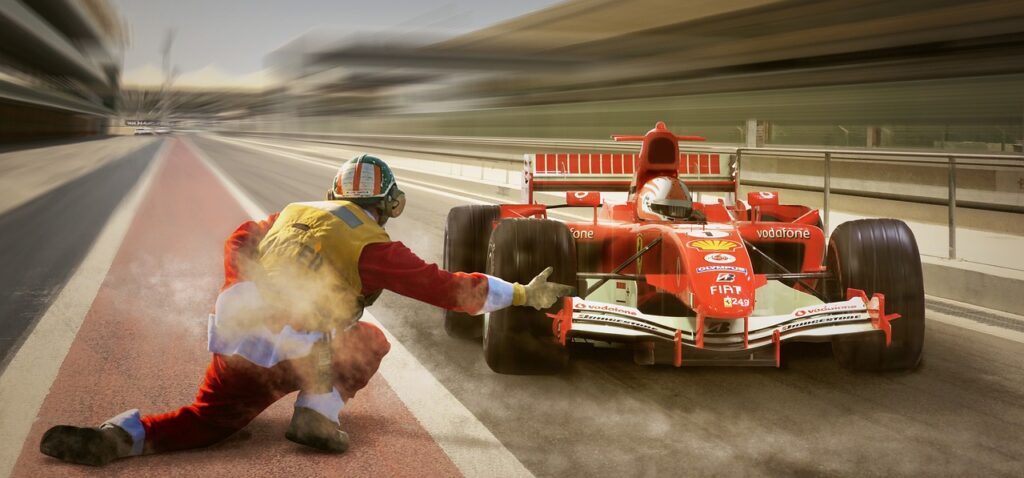
Hungary was, in the broadcast’s own framing, a race dominated by strategy — and that has been the defining texture of 2026. New tyres with unfamiliar degradation curves plus active aerodynamics that change following-distance maths have made the undercut window the most valuable real estate on a Sunday. Budapest’s decisive sequence was not an overtake: it was Piastri and Leclerc stopping on lap 18, Norris a lap later, and all of them queuing behind Hadjar’s off-sequence Racing Bull — track position briefly belonging to whoever cleared the rookie first. Piastri did, into Turn 1 on lap 19; Norris needed until Turn 2; Hadjar then pulled aside for Verstappen entirely.
That two-lap sequence decided the podium order more than any wheel-to-wheel moment, and it is why we keep pointing readers to the mechanics in our tyre strategy explainer: under these regulations, the sporting contest has migrated toward the pit wall. Whether that is a feature or a bug depends on your taste — but it rewards operationally clean teams, which is quietly another Mercedes advantage.
Active aero: the variable nobody has mastered
The replacement of DRS-era aerodynamics with active systems — covered in depth in our active aero guide — was supposed to be the great equaliser for following cars. Half a season in, the honest verdict is mixed. Following is easier; passing is not automatically more frequent, because every driver now manages the same energy-and-drag budget and the defending car has tools too. What active aero has genuinely changed is qualifying, where deployment strategy across a single lap separates teammates in identical machinery. It is not a coincidence that the tightest pole margin of the season — 0.012 seconds in Budapest — came at the track where deployment efficiency matters most per corner. Our refresher on how F1 qualifying works covers the format; 2026 has simply raised the price of getting the last two corners wrong.
The grid’s new arrivals, graded at half-term
The grid’s new arrivals, graded at half-term
The 22-car field is the other genuinely new thing about 2026, and this pause in the calendar is the natural checkpoint for a first honest verdict on the projects that expanded the grid. Both newcomers arrived promising patience; only one has needed the excuse so far.
- Audi — the stronger newcomer-adjacent project. Nico Hülkenberg reached Q3 in Hungary and the car is a regular midfield presence alongside Racing Bulls and Alpine, ahead of Haas on one-lap pace.
- Cadillac — a harder first half. Valtteri Bottas and Sergio Pérez qualified 21st and 22nd in Budapest, more than 2.6 seconds off pole. The experience of the driver pairing is keeping race Sundays tidy; the car is not yet close.
- Racing Bulls’ rookie — Arvid Lindblad out-qualified the entire midfield in Hungary to take ninth. Between him and Antonelli, the 2026 rookie class is out-performing the regulation chaos around it.
The rest of the grid, tier by tier
Beneath the front four teams, Budapest’s qualifying sheet doubles as a season summary. The midfield belongs to Racing Bulls, Alpine and Audi: Lawson, Gasly, Colapinto and Bortoleto filled positions 11-14, comfortably clear of Haas. Historical qualifying archives at StatsF1 will record 2026 as one of the tightest midfields of the modern era — four teams routinely covered by a couple of tenths.
The strugglers are more surprising than the stars. Williams had both cars out in Q1 in Hungary, Sainz and Albon within a few hundredths of each other and nowhere near Q2 pace. Aston Martin’s weekend was worse: Alonso out in Q2 in 16th, Stroll on the back rows — a team whose winter hype has not survived contact with the season. Haas sit between those two fates, with Bearman’s one-lap pace flattering a car that fades on Sundays. Regulation resets create losers as efficiently as winners; the second half will show which of these three can develop their way out.
What eleven rounds tell us about the title fight
What eleven rounds tell us about the title fight
Antonelli leads, with George Russell in the fight from the other Mercedes and Norris now the form driver. The structural read is more interesting than the order. Mercedes’ advantage has been qualifying-built — and Hungary proved that edge is no longer safe. McLaren’s Budapest upgrade worked on a track that rewards exactly the high-downforce characteristics the champions understood better than anyone under the old rules. If that upgrade travels to conventional circuits, the second half of the season is a straight fight between Antonelli’s points cushion and Norris’s momentum.
Driver deals in this sport are option-clause lattices more than fixed terms — our sports contracts guide explains why — and Verstappen is the wild card in the truest sense: quick everywhere, dominant nowhere, and driving a Red Bull power unit project that will define the team’s decade regardless of this season’s outcome. Ferrari, meanwhile, have the second-fastest car on Saturdays and a penalty problem on race weekends — Hamilton has now been penalised in successive events, and points conceded to stewards are the one deficit no upgrade fixes.
Our half-term prediction: Antonelli holds on. Not because Mercedes stays fastest — we think McLaren finishes the year with the best car — but because the points already banked, plus Mercedes’ operational cleanliness, are worth more than a late car advantage split between two McLaren drivers. We are also on record now: Lindblad scores a podium before the season ends.
What to watch when the season resumes
Four questions will decide the second half, and each has a specific tell worth watching in the first race back.
- Does McLaren’s upgrade travel? Budapest rewards high downforce; the first conventional circuit after the summer break is the real exam. If Norris qualifies within a tenth of the Mercedes there, the title fight is fully live.
- How does Piastri respond? A mechanical failure while leading, on the weekend his teammate won, is the kind of swing that defines a driver’s season. His lap-one aggression in Hungary — straight past Leclerc off the line — suggests the answer will not be passive.
- Can Ferrari stop donating grid places? Hamilton has now taken penalties in successive events. The car is the second-fastest over one lap; the operation is costing it points a rebuild cannot recover.
- Does Red Bull’s power unit close the gap? Verstappen’s season has been a masterclass in extracting podiums from the third-best package. Any winter-carryover development that arrives late in the year previews 2027’s order.
Key takeaways
Key takeaways
- Antonelli leads the championship at the summer break in his and Mercedes’ best start to a regulation era.
- Norris’s Hungary win from pole — by 0.012s over Hamilton — ended Mercedes’ 2026 qualifying streak.
- Piastri’s mechanical failure while leading was the pivotal reliability moment of the title race so far.
- Audi and rookie Lindblad are over-delivering; Cadillac’s first car remains 2.6s+ off the pace.
- Ferrari’s Saturday pace keeps being undone by penalties — the pattern, not the pace, is the problem.
Frequently asked questions
Who leads the F1 championship at the 2026 summer break?
Kimi Antonelli leads the drivers’ championship for Mercedes after 11 rounds, having extended his advantage with a podium recovery drive at the Hungarian Grand Prix on 26 July.
Who won the 2026 Hungarian Grand Prix?
Lando Norris won from pole position for McLaren, ahead of Max Verstappen and Kimi Antonelli. Norris’s pole lap of 1:17.207 beat Lewis Hamilton by 0.012 seconds before Hamilton dropped to fifth on the grid with an impeding penalty.
What changed in the F1 2026 regulations?
The 2026 rules introduced new power units with a much larger electrical component, active aerodynamics in place of DRS, smaller and lighter chassis, and revised tyres. The reset scrambled the competitive order, with Mercedes converting development time into an early advantage.
How are Cadillac and Audi performing in their first F1 season?
Audi is the stronger of the two: Nico Hülkenberg reached Q3 in Hungary and the car sits in the midfield fight. Cadillac’s Bottas and Pérez qualified on the back row in Budapest, over 2.6 seconds off pole, with the project still in its build phase.
When does the F1 season resume after the summer break?
Formula 1’s summer shutdown follows the Hungarian round, with the season resuming for the European run-in ahead of the flyaway races. The title fight resumes with Antonelli defending his lead from Russell, Norris and Verstappen.
The summer break gives every factory four weeks to answer those questions, and half a season of the new rules has settled almost nothing — which is the best advert the regulations could have asked for. We will pick the story back up at the resumption in our motorsport section.