
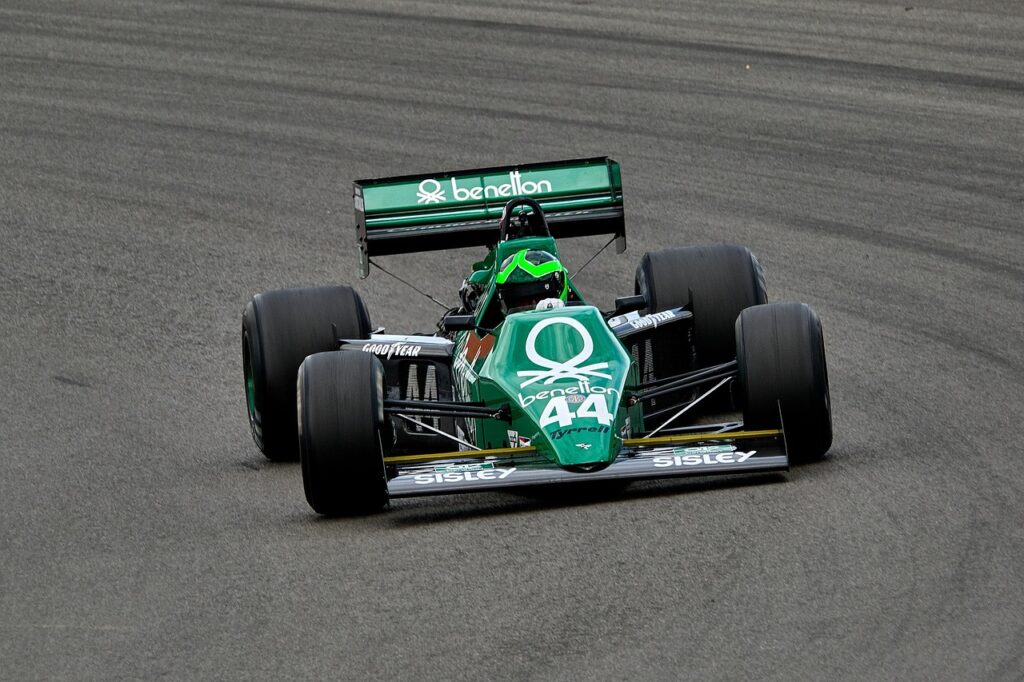
Ranking the greatest F1 drivers of all time is the argument that never ends, and that is exactly why it is worth having. Seven decades of racing have produced a small group of names that stand above the rest.
This is our ranking. We looked past raw win totals alone and weighed championships, the machinery each driver had, the rivals they beat, and the moments that defined them when it mattered most.
- Lewis Hamilton and Michael Schumacher share the record with seven titles each.
- Juan Manuel Fangio won five championships in the 1950s with four teams.
- Ayrton Senna ranks high on impact and pure speed despite three titles.
The title count at a glance
Before the ranking, here is how the most-decorated champions compare on world titles alone. The chart makes one thing plain: two men sit clear at the top, and the gap to the rest is real.
How we ranked the greatest F1 drivers
Titles are the starting point, not the finish line. A driver who won four championships in a dominant car is not automatically ahead of one who won three while dragging an average machine onto the podium.
Our view at Unicorn Blogger is that context separates the great from the merely successful. We weighed how a driver performed against a team-mate in identical equipment, how they drove in the wet, and whether they raised their game when a title was on the line. Pure speed earns respect, but the drivers at the top of this list combined it with the consistency to win over a full season, year after year. That blend is rarer than any lap record.
1. Lewis Hamilton
Hamilton holds the records that matter most by volume: seven world titles, more than 100 race wins, and more pole positions than any driver in history. He won his first championship in 2008 by a single point on the last corner of the last lap, then built a second dynasty with Mercedes from 2014 onward.
What lifts him to the top is range. He won in the V8 era and the turbo-hybrid era, beat strong team-mates in equal cars, and remained a front-runner deep into his late thirties. No driver has won at the front for as long against as many different rivals.
2. Michael Schumacher
Schumacher redefined what total commitment to a race team looked like. Five straight titles with Ferrari from 2000 to 2004 capped a career of seven championships and 91 race wins, a victory record that stood until Hamilton passed it in 2020.
He was the benchmark for a generation, the driver everyone else measured themselves against. His wet-weather drives, his fitness, and his ability to build a team around him set standards the sport still uses today. The line between ruthless and unsporting blurred at times, but his place near the summit is beyond argument.
3. Ayrton Senna
Senna won three titles, fewer than several names below him, yet he sits this high because of what he meant to the sport. Over a single qualifying lap he was the fastest driver many rivals ever saw, and his 65 pole positions came in an era of far fewer races than today.
His rivalry with Alain Prost defined the late 1980s, and his drives in the rain, most famously at Donington in 1993, remain reference points for car control. His death at Imola in 1994 changed Formula 1 safety forever. Few drivers have left a longer shadow.
4. Juan Manuel Fangio
Fangio won five world championships in the 1950s, a tally that stood as the record for decades. More striking is how he did it: he took titles with four different constructors, a feat no one has matched, in an era when a mistake could be fatal.
He won 24 of the 52 championship races he started, a strike rate that looks almost impossible by modern standards. Judging drivers across eras is hard, but Fangio’s dominance of his own time is as complete as anyone’s.
5. Alain Prost
Nicknamed The Professor for his calculated style, Prost won four titles and 51 races between the early 1980s and 1993. He rarely had the fastest car every weekend, so he managed races, tyres and fuel better than anyone, winning championships on points others left on the table.
His battles with Senna, first as McLaren team-mates and then as fierce rivals, produced some of the sport’s most charged moments. Prost proved that intelligence and consistency could beat raw speed over a season.
6. Max Verstappen
Verstappen is the dominant force of the current era and already among the most successful drivers the sport has produced. His relentless aggression, allied to a Red Bull team built around him, turned several recent seasons into processions.
He is the one active driver with a real claim to climb this list further. If he keeps winning at his current rate, the only question is how high he finishes, not whether he belongs. For where his season stands now, see our Verstappen 2026 reset.
7. Sebastian Vettel
Vettel won four consecutive titles with Red Bull from 2010 to 2013, the youngest driver to reach that mark at the time. At his peak he was close to unbeatable, stringing together pole positions and lights-to-flag wins with cold efficiency.
His later years at Ferrari never delivered the championship the partnership promised, which is why he sits behind the names above. Even so, four straight titles is a feat only a handful have managed.
8. Niki Lauda
Lauda won three titles across two spells and two teams, but his story is bigger than the number. His near-fatal crash at the Nurburgring in 1976, followed by a return to racing just six weeks later, is one of sport’s great acts of courage.
He was a cerebral driver and a sharp judge of machinery, qualities that later made him a successful team figure. Lauda earned his place here for substance, not sentiment.
9. Jim Clark
Clark won two titles, in 1963 and 1965, but ask drivers from his era and many will name him the most naturally gifted of all. He took 25 wins from just 72 starts, a strike rate that speaks to total command of any car he sat in.
He won across disciplines too, taking the Indianapolis 500 in 1965 in the same period he was winning Grands Prix. His death in 1968 robbed the sport of a talent still near his peak. On pure ability, few rank lower than the very top.
10. Jackie Stewart
Stewart won three world titles between 1969 and 1973 and 27 races in a short career he chose to end on his own terms. He combined silky car control with a sharp tactical mind, picking his moments rather than chasing every lap record.
His lasting legacy runs deeper than results. After losing friends to the dangers of 1960s racing, Stewart led the campaign for safety that reshaped the sport, work that has saved countless lives since. Greatness on this list is not measured by wins alone.
Just outside the top ten
A few names pushed hard for a place. Fernando Alonso won back-to-back titles in 2005 and 2006, ending Schumacher’s run, and his longevity at the front has made him a reference point for racecraft across two decades. On talent he belongs in almost any conversation; a long stretch in uncompetitive cars kept his title count lower than his ability deserved.
Nigel Mansell brought raw aggression and won the 1992 title with 31 career victories, while Nelson Piquet collected three championships in the 1980s with a cooler, more calculating approach. Each of these drivers would top the all-time list of several rival nations. That is the depth this ranking is fighting through, and it is why the order shifts depending on which qualities you value most.
What a title count cannot tell you
The danger with any ranking is treating championships as the whole story. They are not. A title often reflects the car as much as the driver, and the history of Formula 1 is full of brilliant racers who happened to peak in the wrong machinery.
That is why we weighed team-mate comparisons so heavily. Beating the driver in the identical car, weekend after weekend, is the cleanest measure the sport offers, because it strips away the advantage of better engineering. By that test, the names at the very top of this list separated themselves not by winning in fast cars, but by making fast cars look faster and ordinary cars look competitive. Our read is that this hidden contest, driver against team-mate, tells you more about true greatness than the trophy cabinet ever will.
The wet-weather test
n
One quality runs through almost every driver on this list: brilliance in the rain. A wet track removes the certainty a fast car provides and hands control back to the person behind the wheel, which is why the great names so often produced their finest drives in the worst conditions.
n
Senna at Donington in 1993, Schumacher carving through the field in Spain in 1996, Hamilton holding his nerve on a flooded track years later. These are the afternoons fans remember long after the points are forgotten. The drivers who rise to the top of any greatest F1 drivers debate share that knack of treating chaos as an opportunity rather than a threat. It is the closest thing the sport has to a pure test of talent, and our top names all passed it again and again.
Our verdict
The top of any greatest F1 drivers ranking comes down to Hamilton and Schumacher, and reasonable fans will split on the order, and honestly, both answers can be defended without much of a stretch. We lean Hamilton for the breadth of his record across two distinct eras, but the gap is wafer-thin.
The more interesting question is who joins them. Our prediction is that Max Verstappen finishes his career inside the top three on this list, and possibly higher, reshaping the order the way Hamilton did before him. For more on the season that could push him there, read our 2026 storylines and browse the full motorsport section. If you enjoy these all-time debates, our greatest Wimbledon champions ranking takes the same approach to tennis.
Frequently asked questions
Who has won the most F1 world championships? Lewis Hamilton and Michael Schumacher share the record with seven titles each, ahead of Juan Manuel Fangio on five.
Why is Senna ranked above drivers with more titles? Senna’s pure speed, qualifying record and lasting influence on the sport lift him above several drivers with higher championship counts.
Could Max Verstappen become the greatest of all time? If he keeps winning at his current rate, he has a clear path into the top three, and a real argument for the top spot in time.
Where can I follow current F1 results? The official Formula 1 site carries live timing, standings and race reports for every round of the season, while the FIA publishes the sport’s official regulations and final classifications.