
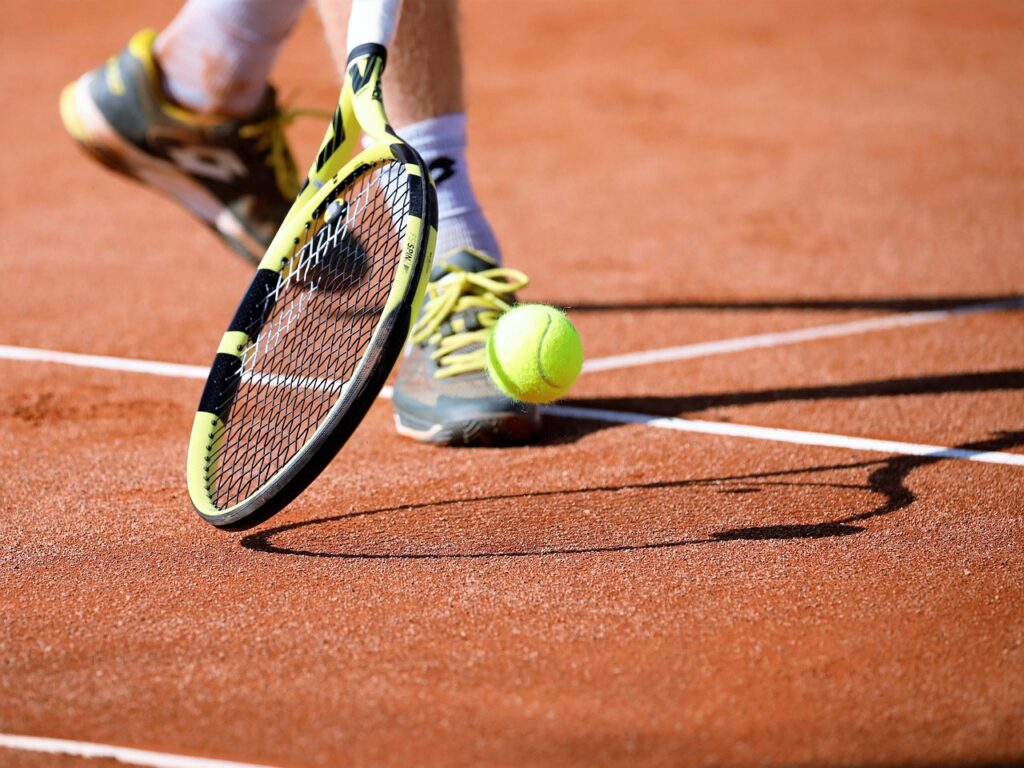
Tennis is the only major sport that crowns its champions on three completely different tennis court surfaces. The same player, with the same racquet, can look unbeatable in Paris and ordinary at Wimbledon three weeks later. The court is not the stage; it is part of the contest.
Understanding how clay, grass and hard courts change the game is the key to understanding tennis itself. Each surface rewards different skills, punishes different weaknesses, and explains why so few players ever master all three.
- Clay is the slowest surface, with high bounce and long rallies.
- Grass is the fastest, with a low skid that shortens points.
- Hard courts sit in between, which is why they test all-round games.
Why the surface changes everything
A tennis ball behaves differently depending on what it lands on, and those differences cascade through every part of the game. Speed off the court, height of bounce, and how securely a player can move all shift from one surface to the next. A forehand that is a winner on grass can be a routine return on clay.
Our view at Unicorn Blogger is that surface is the most underrated variable in the sport, because casual fans see the same players and assume the same game. It is not. The tactics, the shot selection, even the footwork change completely. The three surfaces effectively turn tennis into three related sports, and the players who win across all of them are doing something genuinely rare.
The speed gap, visualised
Court speed is measured by how quickly the ball comes off the surface and how low it stays. The gap between the slowest and fastest is wide, and it shapes every match played on them.
Clay: the great equaliser
Clay is the slowest surface in tennis, and it changes the game more than any other. The loose granular top layer grips the ball, killing pace and kicking it high, which gives defenders extra time to chase down shots that would be winners elsewhere. Rallies stretch to twenty, thirty strokes, and matches become tests of patience and stamina.
This rewards a particular type of player: the heavy topspin hitter who can construct points and grind opponents down. Rafael Nadal is the defining example, with a record fourteen French Open titles built on brutal topspin and relentless court coverage. Clay also allows sliding into shots, a skill in itself, and it punishes the flat, first-strike hitters who thrive on quicker courts. On clay, the player who can stay in the rally one shot longer usually wins.
Grass: where points are won in seconds
Grass is the opposite of clay in almost every way. It is the fastest surface, and the ball skids low off the slick blades rather than bouncing up. Points are short, often decided by the serve and the first shot after it, and there is little time to set up an elaborate rally.
For decades this rewarded the serve-and-volley specialist, the player who could fire a big serve and rush the net to finish the point. Pete Sampras and the early Roger Federer thrived here, and the low bounce flattered players with clean, penetrating ground strokes. Footing is trickier on grass, especially early in a tournament before the surface wears, which adds a layer of unpredictability. A returner gets fewer chances, so every break point carries enormous weight.
Hard courts: the all-round test
Hard courts sit between the two extremes, which is exactly why they are the toughest test of a complete game. The bounce is true and predictable, the speed is moderate, and there is nowhere to hide a weakness. Two of the four Grand Slams, the Australian Open and the US Open, are played on hard courts, so success here is essential to any great career.
Because the surface does not heavily favour either attacking or defending, it rewards the player who can do both. Novak Djokovic has dominated hard-court tennis precisely because his game has no obvious flaw, blending defence, returning and aggression. The trade-off is physical: hard courts are unforgiving on the body, with no give underfoot, which is why they draw the most criticism from players worried about long-term injuries. On hard courts, versatility beats specialisation.
Why the career Grand Slam is so rare
Winning all four majors, and therefore all three surfaces, is one of the hardest feats in sport. It requires a player to master slow and fast, high bounce and low, attacking and grinding, often within the same calendar year. Only a handful of men and women have ever completed the set.
The reason is that the skills can pull against each other. The heavy topspin that wins on clay can sit up invitingly on grass. The flat, aggressive game that wins on grass can sail long on a slow clay court. A player has to own contradictory styles and switch between them on demand. That is why the very greatest, the ones who win everywhere, stand apart from the surface specialists who dominate a single major but struggle at the others.
The homogenisation debate
One of the biggest talking points in modern tennis is whether the surfaces have grown too similar. Since the All England Club changed its grass seed in 2001, Wimbledon’s courts have played slower and bounced higher than the lightning-fast lawns of the 1990s. Some hard courts have been slowed too, partly to produce longer, more television-friendly rallies.
The result, critics argue, is that the same baseline-heavy style now wins almost everywhere, eroding the distinct identities of the surfaces. Our read is that the differences still matter a great deal, clay remains a world apart, but the gap between grass and hard has narrowed. That convergence is part of why the modern era produced players who could win on everything, where earlier generations were often locked into one or two surfaces. Whether that is good for the sport depends on whether you value variety or all-court mastery.
The specialists who proved how much surface matters
The clearest evidence for the power of the surface is the players who dominated one and struggled on the others. Rafael Nadal is the ultimate example, turning the clay of Roland Garros into private property with fourteen titles while taking longer to conquer the faster courts. His topspin, lethal on a high-bouncing clay court, was merely very good on low-skidding grass.
The reverse existed too. Through the 1990s a string of big-serving players reached Wimbledon finals on the back of one weapon, only to fade on the slow clay of Paris where that serve gave them far less. There have always been clay-court specialists who win in the European spring and vanish by the grass season, and grass-court raiders who do the opposite. These careers are not failures; they are proof that the surfaces demand genuinely different skill sets, and that being world-class on one guarantees nothing on another.
How equipment quietly changed the game
Surfaces are only half the story. The other half is what players hold in their hands. The shift from wooden racquets to graphite, and later the arrival of polyester strings in the early 2000s, transformed how much spin a player could generate. Heavy topspin became possible at far higher speeds than before.
That mattered enormously for the surface debate. More spin made the high, looping clay-court game more effective, and it also let players control aggressive shots that would once have flown long. Combined with the slowing of grass and some hard courts, the new equipment helped the baseline game travel across all three surfaces. A player in the 1980s often had to rebuild their style for each surface; a modern player can lean on the same heavy topspin almost everywhere and simply adjust the margins. Technology, as much as groundskeeping, narrowed the gaps between the courts.
What the rally data reveals
The numbers behind the surfaces tell their own story. On clay, average rally lengths are the longest in the sport, with points routinely stretching past eight or nine shots as players trade from the baseline. The slow bounce simply gives defenders the extra fraction of a second they need to return the ball one more time.
Grass sits at the opposite end. Rallies are the shortest of any surface, and a far higher share of points end within the first four shots, many on the serve itself. Aces and unreturned serves spike on grass and fall away on clay, where even a big delivery sits up to be returned. Hard courts land in the middle on almost every measure, which is exactly why they reward the most balanced game. Read those patterns and a match makes more sense before a ball is even struck: on clay, settle in for a war of attrition; on grass, expect lightning; on hard, watch for the player who can do both. The data confirms what the eye already suspects, that these are three distinct contests wearing the same name.
Why geography shapes surface specialists
n
Surface preference often starts in childhood, long before a player turns professional. The courts a young player grows up on shape the game they build, and that leaves a clear geographic fingerprint on the sport. Spain and much of South America are covered in clay, and they have produced wave after wave of patient, topspin-heavy grinders who feel at home in long baseline rallies.
n
Contrast that with nations where hard courts and indoor centres dominate, which tend to produce flatter, more aggressive hitters comfortable taking the ball early. Grass, now rare outside a short stretch of the calendar, produces almost no pure specialists at all, which is part of why the grass season feels like an adjustment even for the best players. A junior who spends a decade sliding on clay does not simply switch that instinct off when they reach a quick court. This is why a glance at where a player came from often hints at the surface where they will feel most dangerous, and why national federations think hard about which courts to build for the next generation, knowing the choice will echo through careers for decades.
What it means for watching the game
Once you know the surfaces, you watch tennis differently. On clay, look for who controls the rally and who tires first. On grass, watch the serve and the first three shots, because that is where the point is usually decided. On hard courts, see who can shift between attack and defence without losing rhythm.
Surface also explains form swings that otherwise look baffling. A player crashing out early on clay and then winning on grass weeks later has not suddenly improved; the conditions have simply started to suit them. Our prediction is that the surfaces will keep gently converging in speed, but clay will always remain the odd one out, and the clay-court specialist will never quite disappear. For more on the players chasing history, see our greatest Wimbledon champions ranking and our French Open guide, or browse the tennis section.
Frequently asked questions
Which tennis surface is the fastest? Grass is the fastest surface. The ball skids low and quickly off the blades, which shortens points and rewards big servers and aggressive hitters.
Why is clay so much slower? The loose granular top layer grips the ball, removing pace and pushing the bounce higher, which gives defenders more time and produces longer rallies.
Why are most hard courts used for two Grand Slams? Hard courts offer a predictable, balanced bounce that tests every part of a player’s game, which is why the Australian Open and US Open are played on them.
Where can I find surface and ranking data? The ATP Tour and WTA Tour sites publish results and rankings broken down by event and surface.
Enjoy these explainers? Read our guide to how the FIFA World Rankings work.
n
Related: Madrid Open 2026 Draw Favourites: ATP Top 5 | Unicorn Blogger